
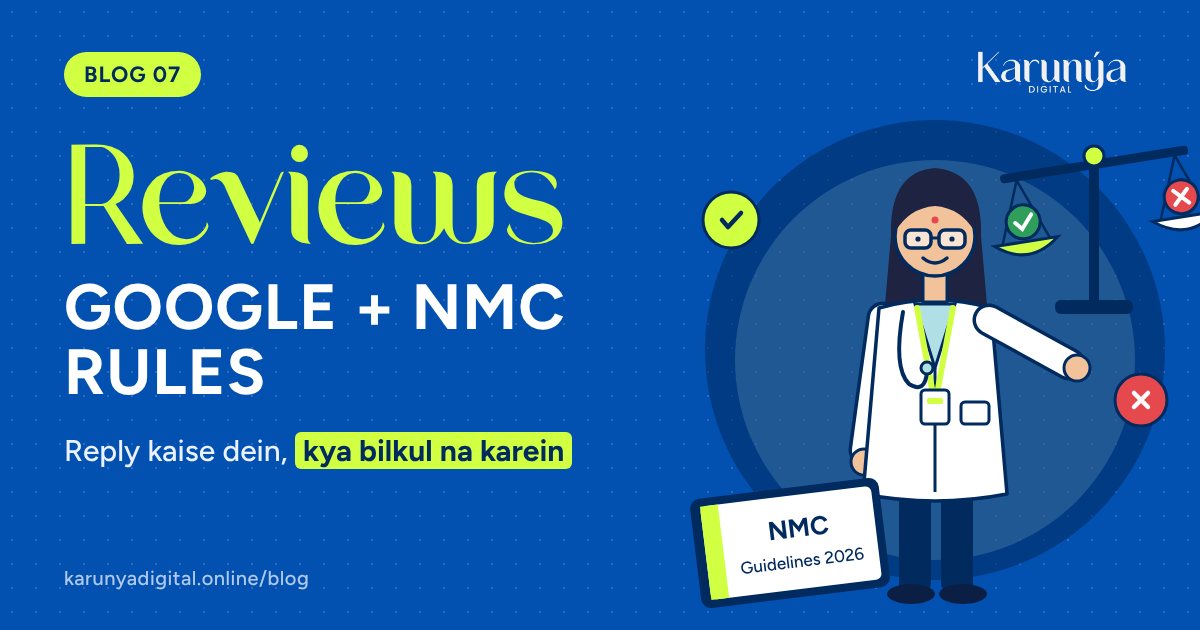
Patients read your Google reviews before they call your clinic. That has not changed. What has changed is the rulebook. Under the NMC's Guidelines on Ethical Advertising and Public Communication (6 October 2026), the way doctors handle Google reviews for doctors under NMC rules now carries real risk if it is done wrong.
This guide explains, in simple terms, what is safe, what is banned, and how to reply to reviews without breaking patient confidentiality.
What the NMC guidelines say about reviews
Reports on the guidelines are clear on a few points:
- Doctors and hospitals must not buy or manipulate patient reviews, ratings, testimonials or endorsements.
- Fake followers, likes, reviews, ratings, comments or views are not allowed.
- Using a third party, such as an agency or influencer, to do this indirectly is also not allowed.
- Using AI to fabricate patient experiences, results or endorsements is banned.
Reported penalties go from a warning and ethics training for a first violation up to suspension of registration for repeat or serious ones. So this is not something to leave to a cheap "review package".
What Google's own rules say
Google has its own policy, and it lines up with the NMC on most points. Google's help page for business owners says offering rewards, such as free or discounted services, in exchange for reviews, changed reviews or removed negative reviews is treated as fake content and is strictly prohibited.
Google Maps has also started asking some visitors directly: "Does this business offer rewards in exchange for reviews?" So incentive schemes are more likely to be spotted than before.
Safe vs risky: a quick table
| Practice | Safe? | Why |
|---|---|---|
| Replying politely to every review | Yes | Shows you care, if you keep medical details out |
| Flagging a review that breaks Google's policy | Yes | Google allows owners to report policy violations |
| Keeping profile details accurate | Yes | Factual information is allowed |
| Paying for reviews or ratings | No | Banned by NMC and Google |
| Discounts or gifts for a review | No | Counts as an incentive; banned by Google |
| Staff or family posting reviews | No | Manipulated reviews |
| Agency "review packages" | No | Doing indirectly what you can't do directly |
| Sharing reviews as testimonials in posts or ads | No | Testimonials are prohibited in advertising |
| AI-written reviews or patient stories | No | Fabricated patient experiences |
Our advice is also not to ask patients for reviews at all. Let reviews come on their own from patients who choose to write them, and put your energy into a good clinic experience and an accurate profile.
How to reply to a positive review
Keep it short, warm and general. Never confirm that the person is your patient, and never mention a condition or treatment.
Good reply: "Thank you for taking the time to write this. Our team is glad you found the clinic easy to visit."
Avoid: "Glad your knee surgery went well and you're walking again!" This confirms a patient relationship and shares health details in public.
How to reply to a negative review
Negative reviews feel personal, but a calm reply helps every future reader.
- Wait a few hours before replying, so you're not writing in anger.
- Don't argue or share details. No dates, no diagnosis, no "our records show".
- Acknowledge and move offline. For example: "We're sorry to hear about your experience. Please call the clinic reception so we can understand and help."
- Fix what's fixable. If many reviews mention waiting time or rude staff, that is useful feedback for the clinic.
Google's own guidance for owners also says to keep replies professional, polite and short, protect privacy and avoid personal attacks.
What to do about a fake or abusive review
Sometimes a review comes from someone who was never a patient, or it contains abuse. You can flag it from your Google Business Profile as violating Google's policies. Stay factual in the report. Don't reply with accusations in public, and don't post a counter-review from friends or staff.
If you need help setting up or cleaning your profile, see our Google Business Profile for doctors checklist.
Where reviews fit in your bigger plan
Reviews are one part of how patients find and judge your clinic. They work best alongside:
- An accurate Google Business Profile with correct timings and map pin
- A simple website with clear service pages (see our SEO for doctors guide)
- Patient-education content on Instagram or YouTube that answers common questions
For the full rule set, read our NMC new guidelines explainer.
Frequently asked questions
Can doctors have Google reviews under the new NMC rules? Yes. Reviews written freely by patients on Google are not banned. What is banned is buying, faking or manipulating reviews and ratings, or using them as testimonials in promotion.
Can I share a good Google review on my Instagram page? It's safer not to. Reposting patient praise to promote your practice can count as a testimonial, which the guidelines prohibit.
Can I delete bad reviews? You can't delete a genuine review yourself. You can flag a review that breaks Google's policies, such as spam or abuse, and reply politely to the rest.
Is it okay for my agency to manage review replies? Yes, if every reply follows the rules: polite, short and with no medical details. Remember that you remain responsible for what an agency posts on your behalf.
Should I offer a discount to patients who leave a review? No. Google treats rewards for reviews as fake content, and the NMC bans manipulated reviews and discount-style inducements.
Want a second opinion on your profile?
Take our free 2-minute Google + Instagram check to see how your clinic looks to patients right now. Or message Karunya Digital on WhatsApp and our team will go through your reviews and replies with you. Plans are on our pricing page.
Sources: Deccan Chronicle: NMC bans fake reviews and misleading ads, Medical Dialogues: third parties and fake engagement, Medical Dialogues: penalties, Google Business Profile Help: reviews, PPC Land: Google Maps asks if businesses paid for reviews